GoHighLevel Onboarding Automation
Built a modular automation system that reduced client sub-account setup from 2 weeks to 10 minutes, processing 15 workflows with built-in error handling.
Project Overview
A GoHighLevel (GHL) SaaS agency needed to dramatically speed up their client onboarding process. What was taking 2 weeks of manual "Done For You" configuration now runs in under 10 minutes through a fully automated workflow system I designed and built.
Impact: Reduced client onboarding time from 2 weeks → 10 minutes — a 99.5% reduction in setup time.
The Challenge
While GoHighLevel's Agency Plan allows owners to spin up sub-accounts from preconfigured snapshots, each new client still requires extensive manual configuration:
- Domain Setup — Custom domain and DNS configuration
- Email Infrastructure — Dedicated email domain with proper authentication
- Business Information — Company details and settings
- A2P Registration — SMS compliance and phone number provisioning
- Custom Values — Client-specific variables and configurations
The manual process was brutal:
- Each client required 2 weeks of back-and-forth setup
- Multiple team members involved across different steps
- High risk of configuration errors and missed steps
- Bottleneck that limited client acquisition capacity
Solution: From Monolith to Modular System
Phase 1: Research & Mapping
I dove deep into the client's documentation and mapped every single step of their onboarding process from start to finish. This revealed the full scope: dozens of configuration steps across multiple GHL systems.
Phase 2: API Integration & Reverse Engineering
The official GHL API covered most functionality, but not everything. I implemented:
- OAuth2 Authentication — Secure API access for the agency account
- Official API Integration — All documented endpoints for sub-account management
- Reverse-Engineered Backend APIs — Discovered and integrated undocumented endpoints to automate steps that weren't publicly exposed
Phase 3: Version 1 — The Monolith
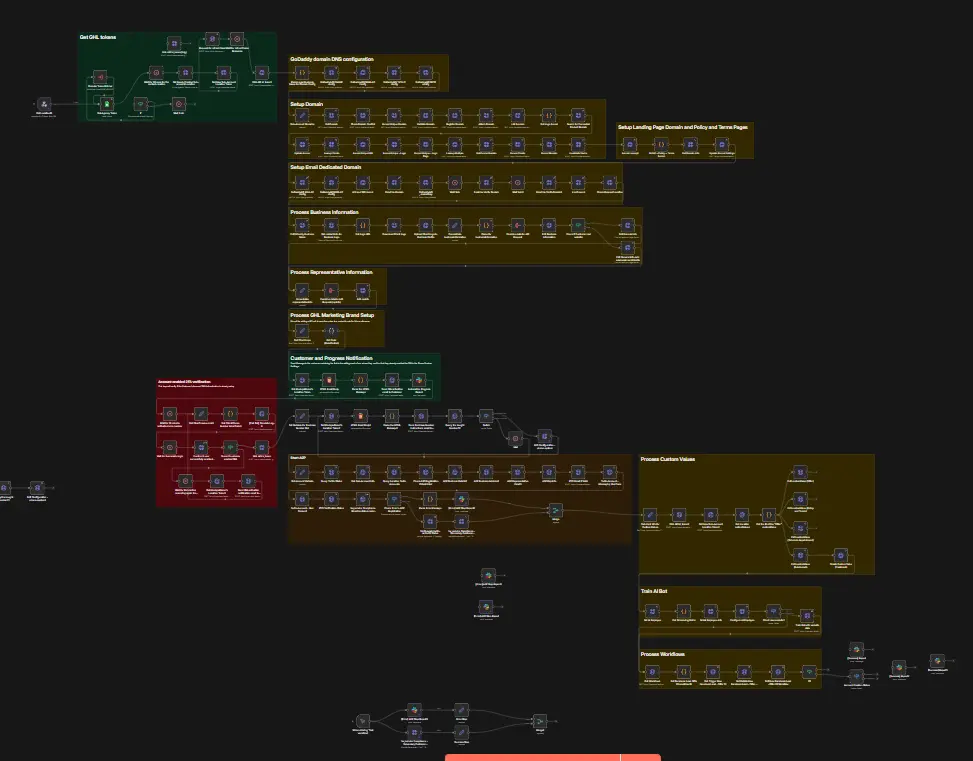
The first version was one massive workflow containing every step to fully configure a client's sub-account. It worked—cutting onboarding from 2 weeks to just 10 minutes—but had a critical flaw:
The system was brittle. If one node failed, the entire workflow broke. I'd have to manually pin data from the previous node just to continue the process. Debugging was a nightmare.
Phase 4: Modular Architecture
I rebuilt the system following software engineering principles—breaking the monolith into independent, reusable modules:
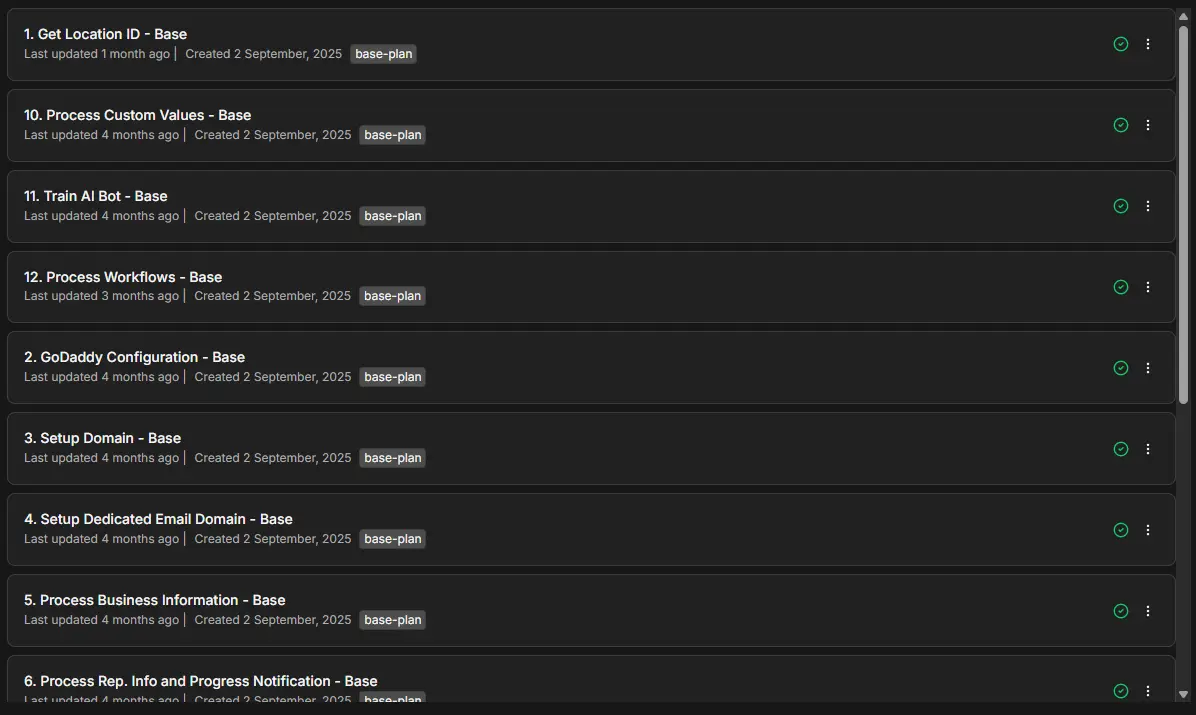
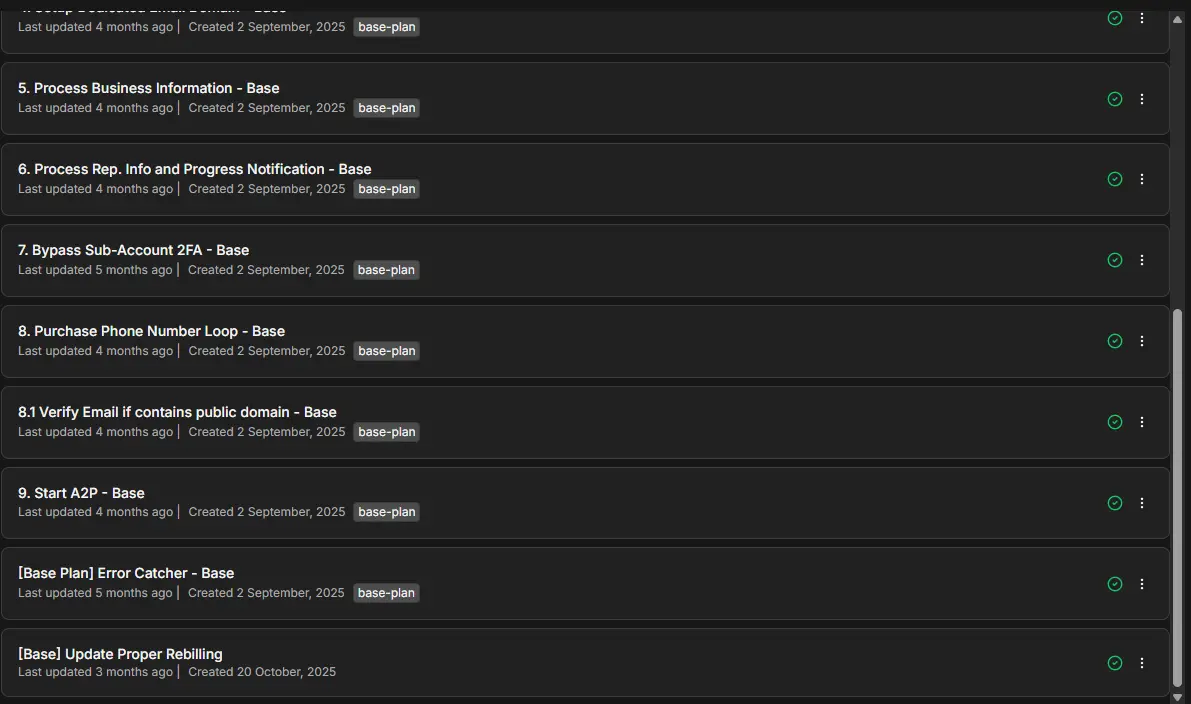
Version 2: 15 independent modules with error handling
Key architectural improvements:
- 15 Independent Modules — Each handles a specific configuration domain
- 13 Core Automations — The essential workflows that run for every client
- Error Catchers — Every module has built-in error detection and notification
- Rerunnable Steps — If a module fails, I can rerun just that step group and the system continues automatically
System Architecture
The modular system consists of these workflow groups:
| # | Module | Function |
|---|---|---|
| 1 | Get Location ID | Retrieve sub-account identifier from GHL |
| 2 | GoDaddy Configuration | DNS records and domain routing setup |
| 3 | Setup Domain | Custom domain configuration in GHL |
| 4 | Setup Dedicated Email Domain | Email authentication (SPF, DKIM, DMARC) |
| 5 | Process Business Information | Company details and branding setup |
| 6 | Process Rep. Info & Notifications | Team member setup and alert configuration |
| 7 | Bypass Sub-Account 2FA | Automated security configuration |
| 8 | Purchase Phone Number Loop | Automatic phone number provisioning |
| 8.1 | Verify Email Domain | Public domain validation checks |
| 9 | Start A2P | SMS compliance registration process |
| 10 | Process Custom Values | Client-specific variable configuration |
| 11 | Train AI Bot | Conversation AI setup and training |
| 12 | Process Workflows | Import and configure automation templates |
Supporting modules: Error Catcher (for each workflow) and Update Proper Rebilling for subscription management.
Results
| Metric | Before | After |
|---|---|---|
| Onboarding Time | 2 weeks | < 10 minutes |
| Manual Steps | 50+ configuration tasks | 1 trigger click |
| Error Recovery | Start from scratch | Rerun failed module only |
| Debugging | Manual log inspection | Automatic error alerts |
Additional benefits:
- Scalability — Can onboard multiple clients simultaneously
- Consistency — Every client gets identical, error-free configuration
- Self-healing — Modular design allows partial reruns without data loss
- Visibility — Error catchers provide instant notification of any issues
Technologies & Integrations
- GoHighLevel API — Official REST API with OAuth2 authentication
- GHL Backend APIs — Reverse-engineered endpoints for advanced automation
- GoDaddy API — Automated DNS configuration
- Sub-Workflows — Inter-module communication and external triggers
Lessons Learned
-
Start monolithic, then modularize — The first version proved the concept. Once I understood the full system, breaking it into modules was much clearer.
-
Error handling is not optional — Every module needs its own error catcher. When you're automating 50+ steps, silent failures are catastrophic.
-
Reverse engineering is sometimes necessary — Official APIs don't always cover everything. Understanding HTTP traffic and API patterns unlocked critical functionality.
-
Think like a software architect — Applying software engineering principles (modularity, separation of concerns, idempotency) to no-code workflows dramatically improved reliability.
Interested in similar solutions?
Let's discuss how I can help with your project.